

Contacts
-

Instrument Scientist
-

Instrument Scientist
-

Instrument Scientist
Magnetism at the nanoscale
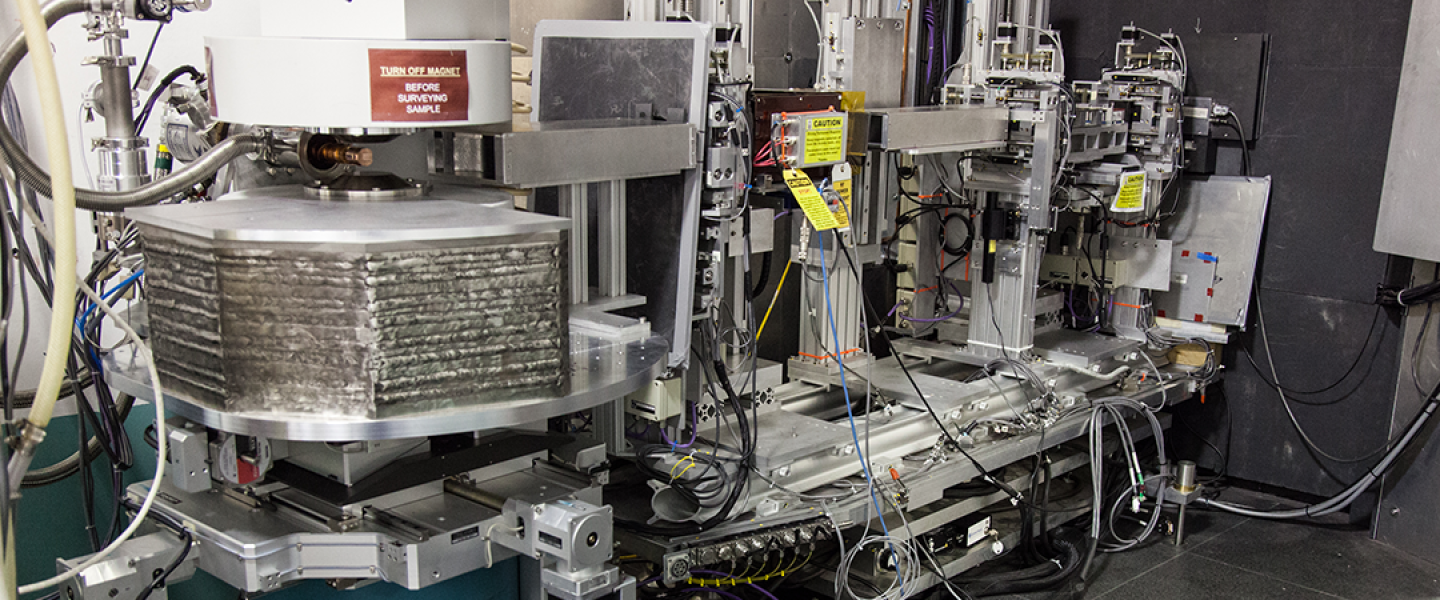
To provide the user community with the capabilities to characterize non-uniform distributions of magnetization in nano-scale and meso-scale materials related to quantum condensed matter in a myriad of environmental conditions.
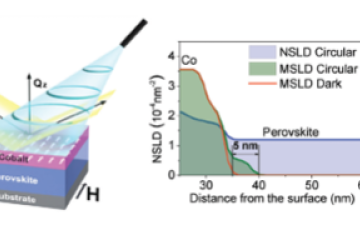
The Magnetism Reflectometer exclusively provides polarized neutron beams for the instrument’s general user program, enabling measurements of specular, off specular reflection and grazing incidence small angle scattering (GISANS) from vertical solid or solid/liquid interfaces. Polarized neutron beams are produced with reflection or transmission polarizers. Polarization analysis of the scattered beams with a mirror analyzer or 3He filter is optionally available. These capabilities enable characterization of non-uniform distributions of magnetism in nano-scale and meso-scale materials.
Research using the Magnetism Reflectometer is primarily focused on studies of materials with a net magnetization—magnetization that can be perturbed by many environmental variables, including magnetic and electric fields, temperature, pressure, stress, and light.
Polarized neutron beams also enable some studies of non-magnetic materials including soft matter; for example, by quantifying incoherent scattering, or phase-inversion using the magnetic reference layer technique [C.F. Majkrzak and N.F. Berk, Phys. Rev. B 52, 10827 (1995)].
| Source- to-sample distance | 18.703 m |
| Sample- to-detector distance | 2.2972 m |
| Detector size | 21 x 18 cm2 |
| Detector resolution | 1.4 mm |
| Moderator | Coupled supercritical hydrogen |
| Bandwidth | 60 Hz (Δλ=3 A), 30 Hz (Δλ=6A) |
| Wavelength range | 1.8 Å < λ < 14.0 Å |
| Q range | 0 Å-1 < Q < 3.5 Å-1 |
| Magnetic field max | 1.2 T with a gap of 50 mm and 3 T with a gap of 10 mm |
| Polarization | Reflection Polarizer P = 99%-96% λ (2A - 10.5A), Transmission Polarizer P = 96%-90% λ (4.5A - 12A) |
| T range | 5 - 750 K |
| Minimum reflectivity | 10-8 |
Instrument Scientist
Instrument Scientist
Instrument Scientist






Oak Ridge National Laboratory is managed by UT-Battelle LLC for the US Department of Energy
