

Contacts
-

Instrument Scientist
-

Instrument Scientist
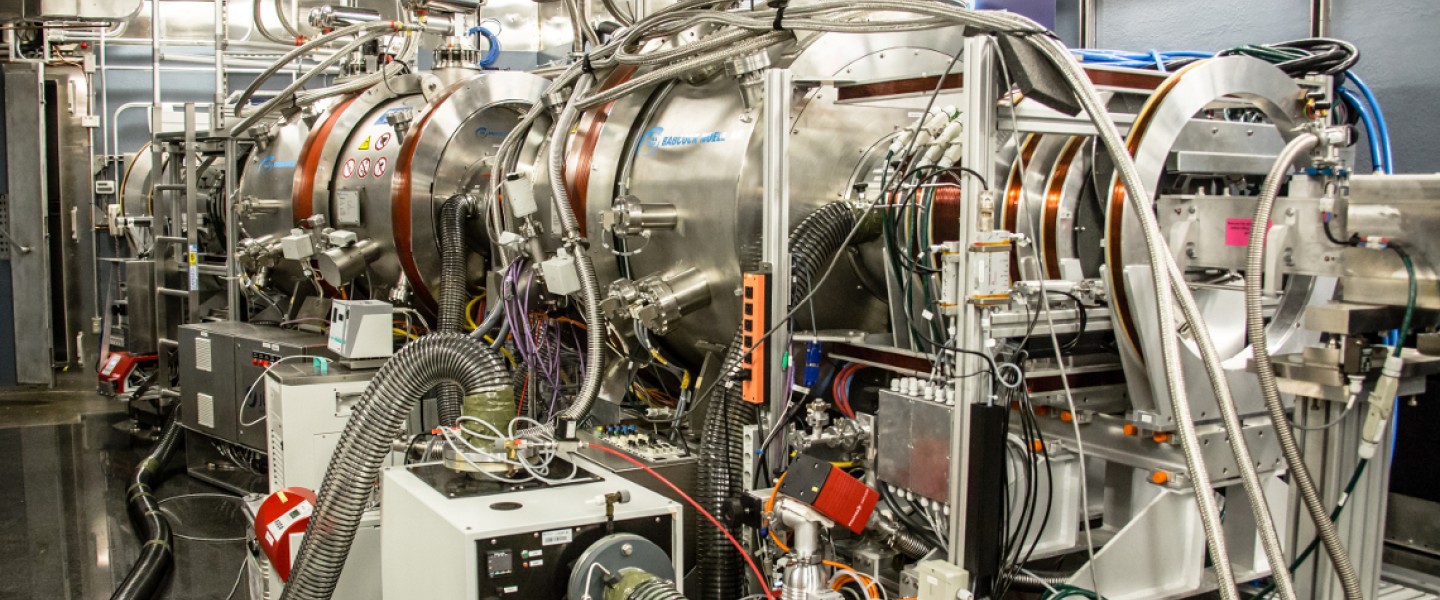
SNS-NSE is an ultrahigh resolution neutron spectrometer for characterizing the slow dynamics of soft condensed matter.
The SNS-NSE is a time-of-flight instrument in which the Larmor precession of the neutron spin in a magnetic preparation field encodes the individual velocities of the incoming neutrons into corresponding precession angles. If the neutron velocity remains unchanged upon scattering from the sample (elastic scattering), a symmetric decoding region compensates for the accumulated precession angle, restoring the initial polarization through spin rephasing, the so-called spin - echo.
If the sample alters the neutron velocity (inelastic scattering), the rephasing becomes incomplete, resulting in a measurable reduction in polarization. This loss of polarization reflects the distribution of differences in neutron flight times through the encoding and decoding precession regions. The precise control of the neutron spin enables the use of an intense beam with a broad wavelength distribution while maintaining sensitivity to relative velocity changes smaller than 10-4.
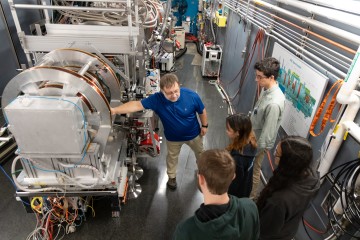
The SNS-NSE spectrometer features a modern design based on superconducting technology, providing highly homogeneous magnetic fields. It further incorporates state-of-the-art field correction elements, advanced polarizing benders, and optimized magnetic shielding to ensure reliable and precise operation.
The SNS-NSE instrument is a high-resolution neutron spin echo (NSE) spectrometer optimized for probing slow dynamical processes and resolving molecular motions across nanoscopic and mesoscopic length scales. It offers unique insight into the mobility of molecular structures governed by thermal fluctuations. A key advantage of NSE is its capability to selectively “label” specific substructures via H/D contrast variation, allowing direct access to the characteristic timescales of targeted molecular components.
Typical applications in soft-matter research include relaxation processes in polymer melts, networks and rubbers, interfacial fluctuations in complex fluids and polyelectrolytes, and transport phenomena in polymer electrolytes and gel systems. In biophysics, the instrument enables studies of protein domain dynamics and enzyme motions, structural and dynamical properties of lipid assemblies and biological membranes, the impact of anti-inflammatory agents on membrane organization, and transport processes across cell membranes.
The spectrometer also grants access to slow magnetic fluctuations in spin glasses and topological spin structures, supporting research in condensed matter physics, materials science, and magnetism.
| λmin [Å] | λmax [Å] | τ min [ps] | τ max [ns] | Qmin [Å-1] | Qmax [Å-1] P2 | Qmax [Å-1] P4 |
| 2 | 5 | 0.1 | 13 | 0.08 | 2.3 | 3.1 |
| 5 | 8 | 1 | 50 | 0.05 | 0.9 | 1.4 |
| 8 | 11 | 5 | 130 | 0.03 | 0.5 | 0.9 |
| 11 | 14 | 12 | 280 | 0.03 | 0.4 |
| Field Integral | Jmax [T m] | 0.56 | |
| Scattering Angle | 2θmax [deg] | 40.0 | at P2 |
| 79.5 | at P4 | ||
| Source to Detector | L [m] | 21.3 | at P2 |
| 27.3 | at P4 | ||
| Field Homogeneity | H [Å2/ns] | 0.7 | |
| Repetition Rate | f [Hz] | 60 |
Instrument Scientist
Instrument Scientist






Oak Ridge National Laboratory is managed by UT-Battelle LLC for the US Department of Energy
