

Better Catalysts for Selective Oxidation through Formation of Hydrided Sites
September 15, 2025
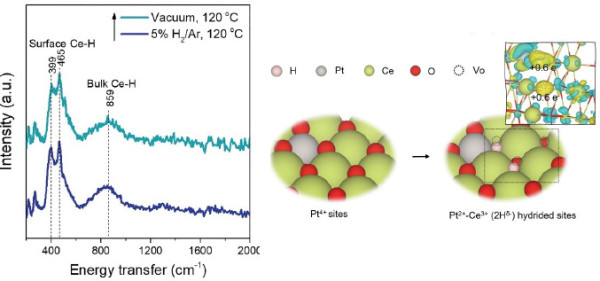
VISION spectra (left) show the formation of hydrided sites (right bottom) from the original sites (right top).
Scientific Achievement
Catalytic Pt1/CeO2 single sites were modified into hydrided (Pt2+-Ce3+Hδ−) and hydroxylated (Pt2+-Ce3+OH) sites that exhibit much higher reactivity and selectivity for several reactions.
Significance and Impact
The achieved 9-fold increase in the reaction rate for carbon monoxide oxidation and 2.3-fold improvement of propylene selectivity for oxidative dehydrogenation of propane provide a major boost for the catalyst performance.
Research Details
- The atomic structure and reaction steps of the catalytic sites were determined with in situ and ex situ spectroscopy techniques and theoretical methods.
- VISION data proved stability of Ce-H hydrides on the surface and in the bulk and ruled out surface species such as adsorbed water.
“Formation of hydrided Pt-Ce-H sites in efficient, selective oxidation catalysts,“ Science 388(6746) (2025) 514-519
https://doi.org/10.1126/science.adv0735