

Nanoscale Water Structure and Dynamics in Transition Metal Carbide MXenes
April 16, 2026
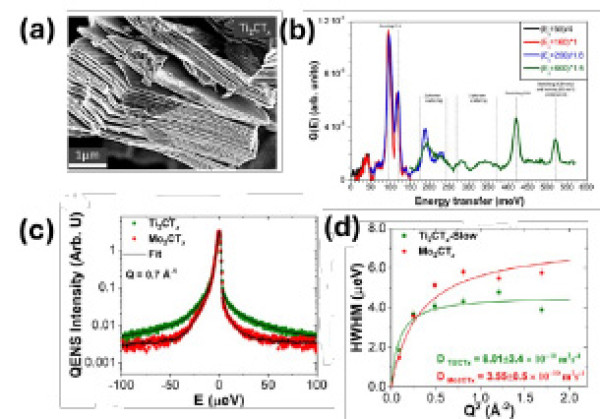
Fig. (a) SEM image of Ti2CTx (b) INS difference spectra showing extra peaks from O-H groups. (c) QENS data comparison with fit at 300 K (d) Jump diffusion model fit resulting in a higher diffusivity of water in Ti2CTx MXene.
Scientific Achievement
Water in Ti₂CTₓ MXene moves faster than in Mo-containing and Ti₃C₂Tₓ MXenes, due to more hydroxyl groups, rougher surfaces, wider gaps and misaligned layers.
Significance and Impact
These results clarify how composition and structure affect water confinement in MXenes and can guide material selection for MXene-based technologies.
Research Details
- Quasi-elastic (QENS) and inelastic neutron scattering (INS) show that most MXenes behave like Ti₃C₂Tₓ, with thicker layers exhibiting stronger hydrogen bonding.
- INS reveals extra hydroxyl-related peaks in Ti₂CTₓ , and QENS confirms confined and bulk-like water populations due to structural heterogeneity and variable interlayer spacing.
- Small-angle neutron scattering (SANS) reveals that Ti₂CTₓ has rougher surfaces, wider gaps and uncorrelated layers, resulting in a distinct diffusion behavior.
“Structure and Dynamics of Water Confined in Transition Metal Carbine Mxenes: Implications for Electrochemical Applications,”
ACS Appl. Nano Mater. 6, 676 (2026).
https://doi.org/10.1021/acsanm.5c05156