

Interface-Induced Stability of Nontrivial Topological Spin Textures: Room-Temperature Hopfions and Skyrmions
June 15, 2026
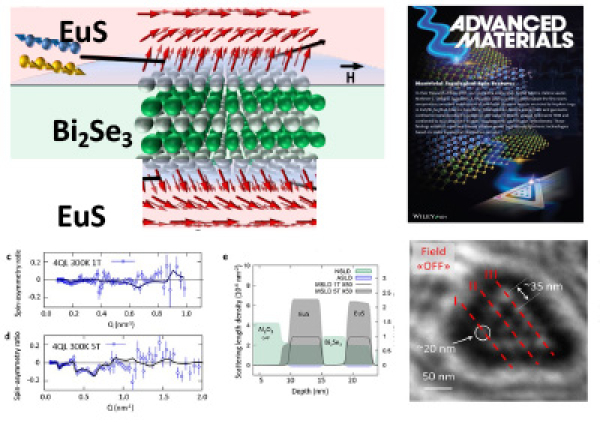
a) Schematic of the PNR experimental set up for EuS–Bi2Se3–EuS film; b) Cover page; c)-d) spin asymmetry and e) structure and magnetization depth profile obtained from the fit; f) Lorentz transmission electron microscope image showing hopfion-skyrmion assembly.
Scientific Achievement
The first observation of hopfion-skyrmion configuration at room temperature in a trilayer heterostructure of EuS-Bi2Se3-EuS thin film far above the bulk Curie temperature of EuS, ~17 K.
Significance and Impact
Provided evidence of a stable topological chiral spin texture that can facilitate the development of information carriers for ultralow-power and high-density information processing.
Research Details
- Skyrmion-hopfion configurations are directly observed with Lorenz transmission electron microscopy at room T.
Polarized Neutron Reflectometry revealed magnetization depth profile and micromagnetic modeling demonstrated a complete picture of how hopfion-skyrmion are controlled by uniaxial anisotropy and Dzyaloshinskii-Moriya interaction.
“Interface-Induced Stability of Nontrivial Topological Spin Textures: Unveiling Room-Temperature Hopfions and Skyrmions,” Advanced Materials 38, 1 (2026).
https://doi.org/10.1002/adma.202511754