

Neutrons Reveal How to Strengthen Armor Steel Welds
February 16, 2026
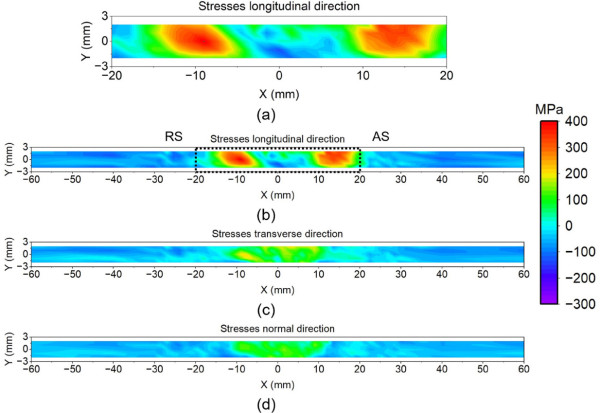
Residual stress maps of friction stir welded armor steel, revealing areas of tensile stress (red/yellow) in the heat-affected zones, while the stir zone remains largely compressive (blue/green).
Scientific Achievement
Identified how residual stress in friction stir welded armor steels is governed by competition between phase-transformation expansion and thermal stress relaxation.
Significance and Impact
The findings establish a framework for engineering better armor systems by tuning welding parameters.
Research Details
- Neutron diffraction mapped residual stress fields in Rolled Homogeneous Armor and High-Hardness Armor.
- Tensile stresses in softened zones remained significantly lower (50–70% of yield strength) than in fusion welds.
- Determined that phase transformation dynamics and local hardenability, not peak temperature, control stress evolution.
“Correlation between microstructure and residual stress formation in friction stir welded armor steels characterized by neutron diffraction," Journal of Materials Processing Technology 349, 119198 (2026)
https://doi.org/10.1016/j.jmatprotec.2026.119198