
Experiment planning
The following steps should be taken to plan a neutron imaging experiment at MARS and/or VENUS.
| Technique | Principle | Example Applications | Instrument selection |
|---|---|---|---|
| Attenuation-Based Radiography | Attenuation contrast | Hydrogen mapping, fuel cell operation, cultural heritage, materials screening | MARS: highest sensitivity and spatial resolution VENUS: highest penetration and wavelength discrimination
|
| Computed Tomography (CT) | 3D reconstruction from projections | Corrosion/hydrogen mapping, battery electrode degradation, porous materials | MARS: fastest CT or highest spatial resolution VENUS: hyperspectral CT, higher penetration |
| Bragg-Edge Imaging (BEI) | Crystallographic edge absorption | Residual stress mapping, phase distribution in metals | VENUS only |
| Phase-Contrast Imaging | Refractive index differences | Soft tissues, low-Z materials, porous foams | MARS: qualitative only (under development at VENUS) |
| Polarized Neutron Imaging | Spin-dependent scattering | Magnetic domain imaging, superconductors | MARS only (under development at VENUS) |
| Dark-Field Imaging | Small-angle scattering effects | Fiber composites, microcrack detection, foams, heterogeneous particle/void distributions | MARS: qualitative only (under development at VENUS) |
| Resonance Imaging | Nuclear capture in epithermal range | Nuclear materials | VENUS: 2D only (3D under development) |
| In Situ/Operando Imaging (time-resolved imaging) | Controlled environment operation | Battery cycling, phase transitions/solubility, fuel cell operation, fluid dynamics | MARS: fastest VENUS: wavelength discrimination, cycling motion, event mode measurements |
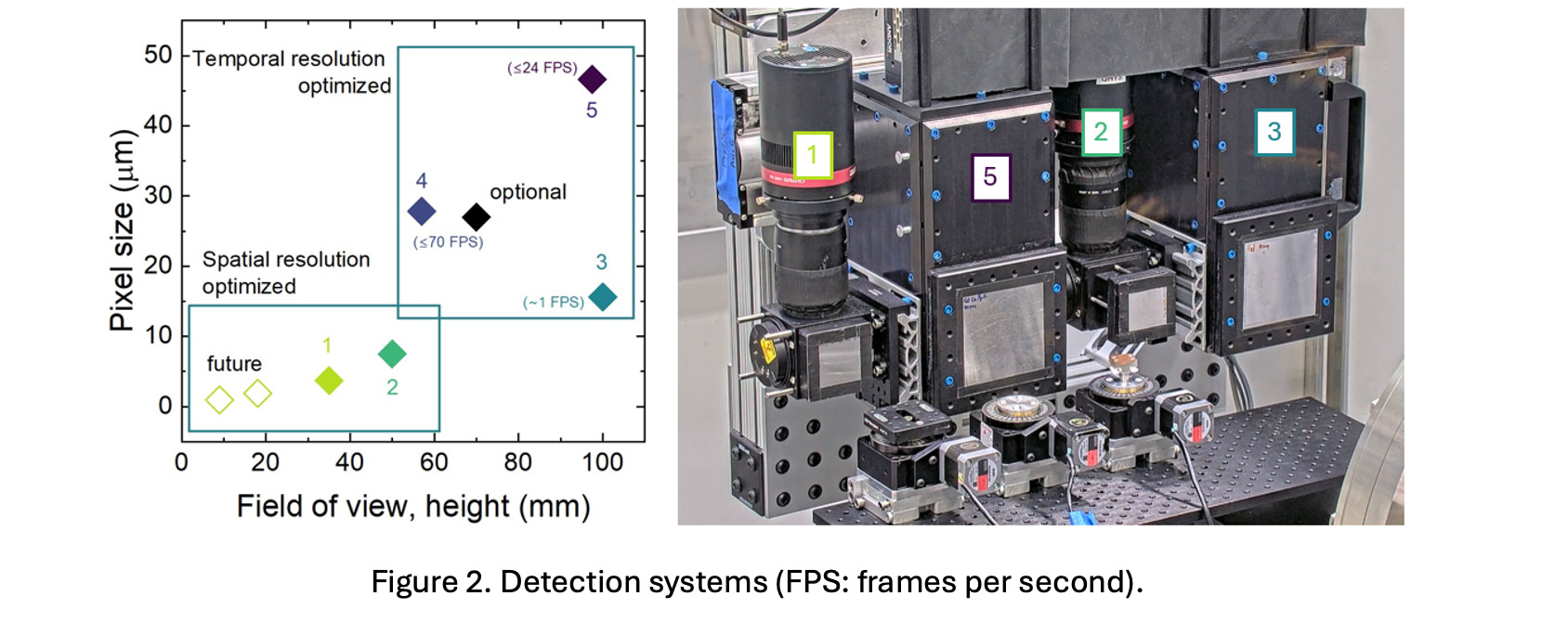
| # | Detector name | Camera model (manufacturer) | Max FOV [cm2] | Pixel size, d [μm] | Best spatial resolution [μm] | Typical exposure time, t [s] | Max fps @16-bit | CT time for ex. 1 [hrs] | CT time for ex. 2 [hrs] |
|---|---|---|---|---|---|---|---|---|---|
| 1 | QHY-S x1 | 3.6 x 2.4 | 3.8 | 10-15 | 900* | 1 | 622 | 2631 | |
| 2 | QHY-S x0.5 | QHY600 sCMOS (QHYCCD) | 5.0 x 5.0 | 7.6 | 20-25 | 300* | 1 | 105 | 441 |
| 3 | QHY-L | 8.6 x 8.6 | 16 | ~50 | 30-90* | 1 | 6-16 | 23-64 | |
| 4 | Marana-6 | Andor Marana 4.2B-6 sCMOS (Oxford Instruments) | 5.6 x 5.6 | 28 | ~90 | 30 | 74 | 3 | 13 |
| 5 | Marana-11 | Andor Marana 4.2B-11 sCMOS (Oxford Instruments) | 9.0 x 9.0 | 43 | ~120 | 30 | 24 | 2 | 8 |
Running the experiment
Users will be trained to safely operate MARS equipment and will be provided with a list of contacts for any issues. Here are some useful links to control or monitor an experiment remotely.
After the experiment
All materials and equipment that were within 30cm of the neutron beam are considered radioactive materials and will require detailed neutron activation calculations, including complete composition, mass, and exposure time, as well as release by a radiological control technician (RCT). Some materials such as steel will remain activated for months to years.
Shortly after the experiment, all data will be normalized, and CT data will be reconstructed. Instrument staff will update the Slack channel with final data location(s).
Note that X-ray imaging/CT after neutron irradiation at MARS is challenging and may not be possible. Discuss these needs with instrument staff.
Publications and reporting requirements
Intent to Publish: As a condition for performing nonproprietary research, the US Department of Energy requires users to publish results from their research. Authorship of publications based on research from these facilities should reflect the normal considerations of recognizing collaborations. It is also important to take into account the considerable efforts of instrument scientists in their role of designing, constructing, and/or operating the instrument and related facilities. Results are typically published in peer-reviewed journals, proceedings, or presentations at technical conferences. Proprietary users are not required to publish.
Credit Line: All publications based on work done in whole, or in part, at the Spallation Neutron Source or the High Flux Isotope Reactor at Oak Ridge National Laboratory should acknowledge the facility (or facilities) with this required statement:
This research [or, A portion of this research] used resources at the High Flux Isotope Reactor [and/or Spallation Neutron Source, as appropriate], a DOE Office of Science User Facility operated by the Oak Ridge National Laboratory. [If applicable: The beam time was allocated to [Instrument] on proposal number IPTS-XXXXX.X.]
In addition, users are asked to credit the instrument(s) used in the body of the paper.
Contribute to Our Publication Records: After your results have been published, submit the paper’s citation information via the Publications Portal.






Oak Ridge National Laboratory is managed by UT-Battelle LLC for the US Department of Energy