

Tristructural Isotropic (TRISO) Fuel Compact Imaged by Neutrons and X-rays
August 14, 2026
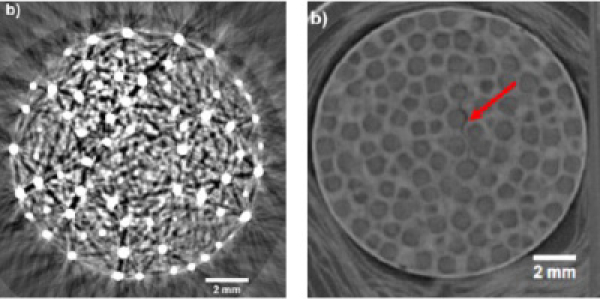
Reconstructed cross-sectional slice from (a) XCT and (b) nCT. XCT shows strong contrast from uranium bearing kernels, but streak artifacts preclude the examination of graphite matrix. In nCT, the graphite matrix and a defect/crack (red arrow) in the fuel compact are revealed.
Scientific Achievement
A natural uranium-based, unirradiated TRISO fuel compact was nondestructively imaged using both X-ray (XCT) and neutron computed tomography (nCT). Complementary structural details were revealed.
Significance and Impact
While XCT maps uranium-bearing fuel kernels, imaging artifacts preclude examination of the graphite matrix. In this work, nCT was used for the first time on a TRISO compact and successfully revealed a crack
Research Details
- XCT were conducted at Idaho National Laboratory’s (INL) using a ZEISS Xradia 620 Versa X-ray microscope (XRM).
- nCT was performed at the Oak Ridge MARS beamline.
- XCT and nCT datasets are co-registered and fused.
"Neutron and x-ray computed tomography of a natural uranium tristructural isotropic (TRISO) fuel compact,” Journal of Radioanalytical and Nuclear Chemistry, 335, 2229-2238 (2025)
https://doi.org/10.1007/s10967-025-10629-7